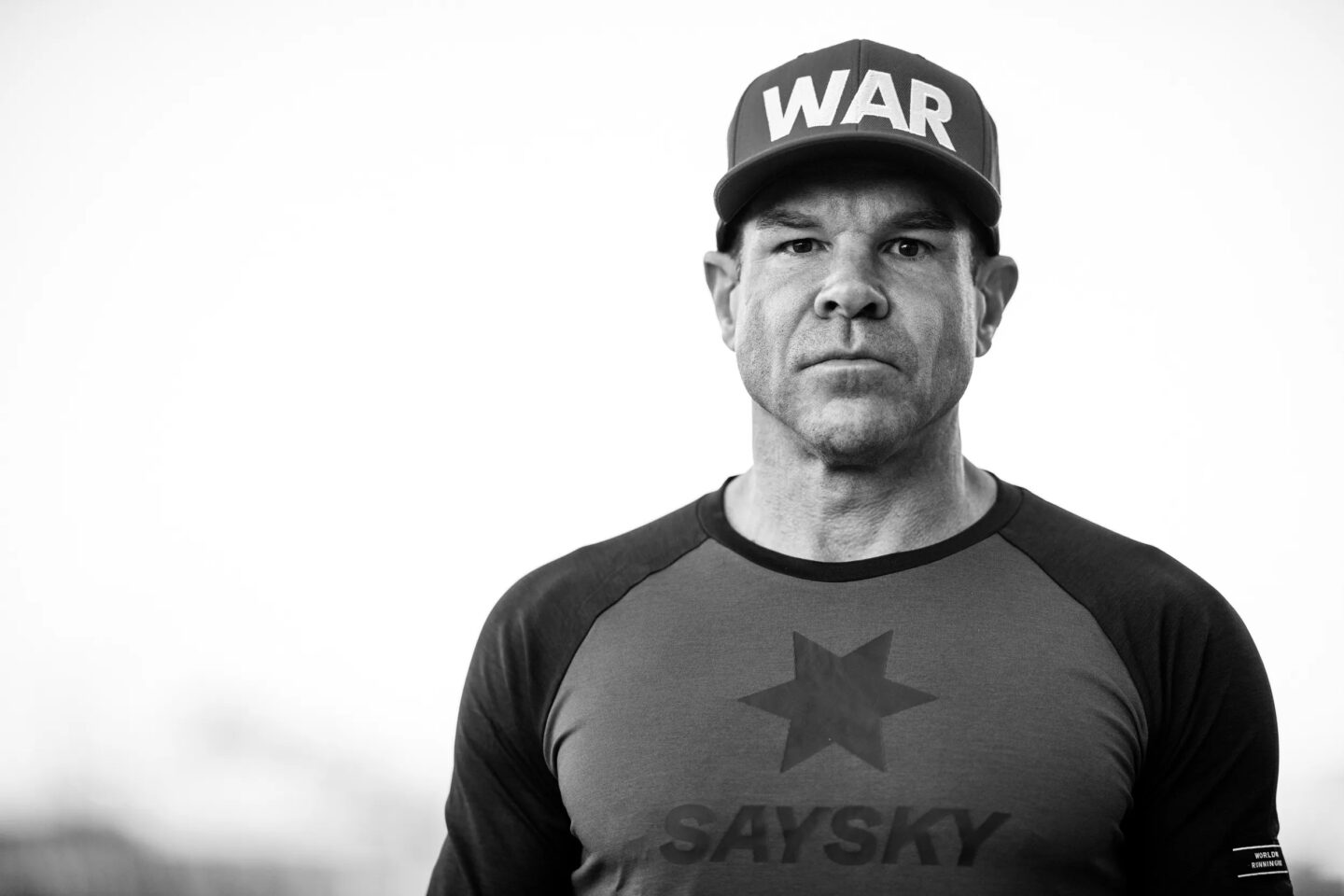
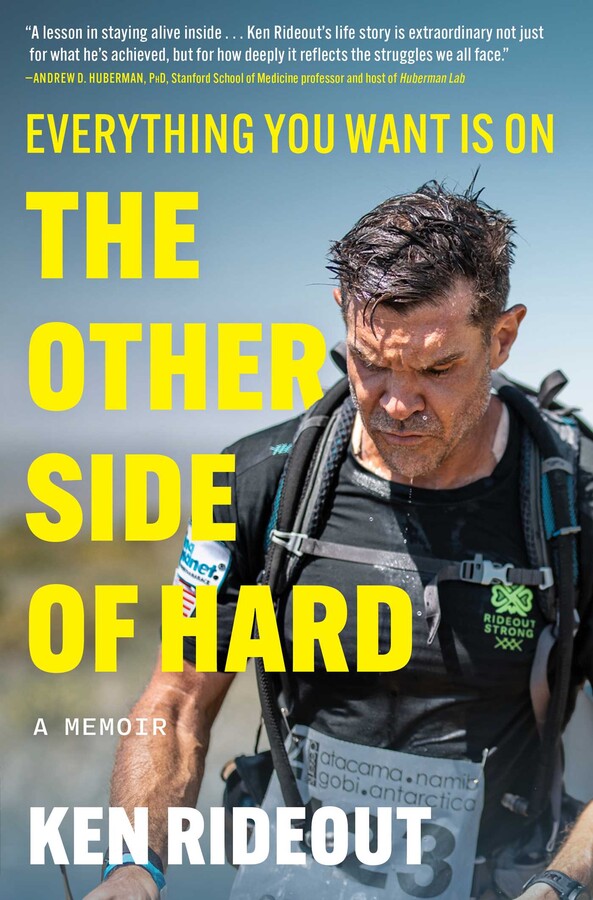
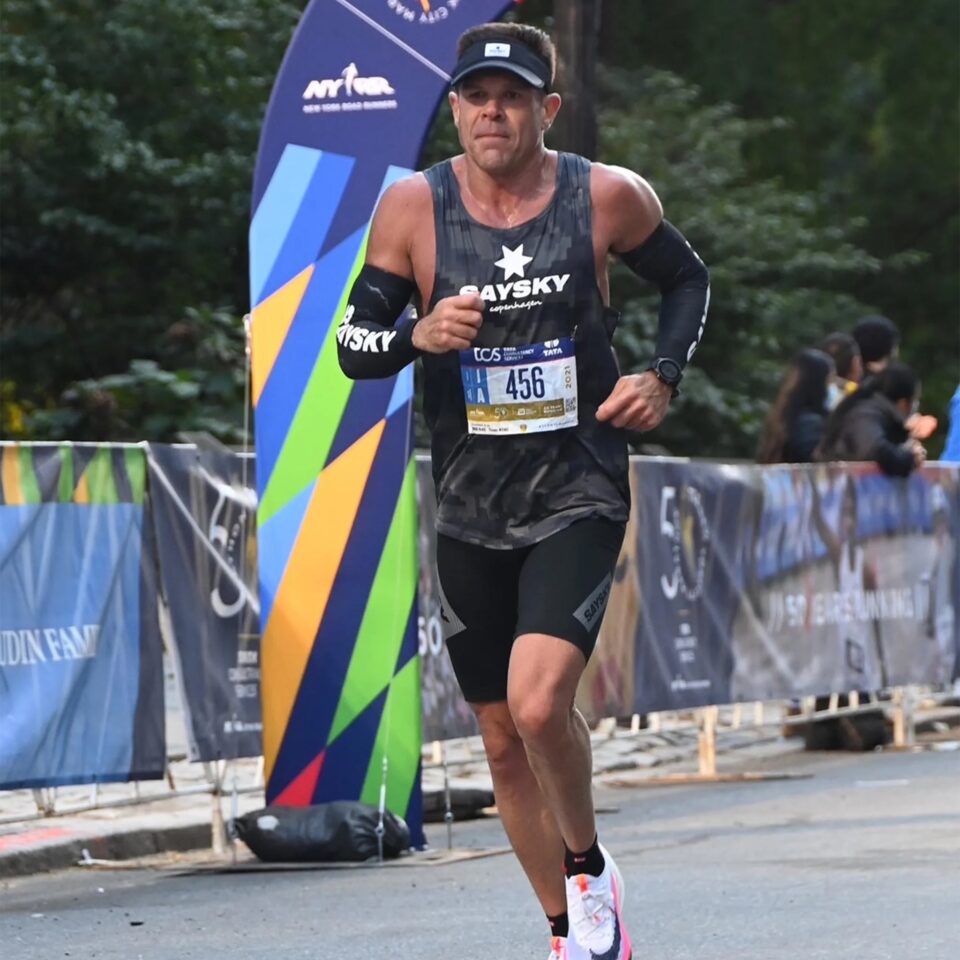
I recently caught up with Ken Rideout, whose memoir, The Other Side of Hard, is now available everywhere books are sold. Ken, who recently turned 55, won the 50-54 age group at the 2023 Abbott World Marathon Majors Championship in Chicago with a time of 2:29:08. Amongst numerous other athletic accomplishments, he also took the Masters division title at the New York City Marathon in 2021, finished second at the 2022 Abbott World Marathon Majors Championship in London, and won the Gobi March, a 155-mile, self-supported ultra through the Gobi Desert, in 2023.
Ken is also someone I’ve had the privilege of coaching since 2019, and this conversation—which we recorded in March, while he was in London on a whirlwind book tour—is a nice complement to the ones we had for episodes 91 and 186 of the podcast.
In this one we talked about the importance of running your own race regardless of what everyone else around you is doing, his complicated relationship with satisfaction and what drives him to keep pushing, what it was like to relive some of the harder chapters of his life in writing the book, and a lot more. It’s a wide-ranging conversation with someone I have an immense amount of respect and admiration for, and I hope you enjoy it as much as I did.
Mario Fraioli: Do you remember the first time you ever saw me?
Ken Rideout: Was it at Tracksmith?
Mario Fraioli: No.
Ken Rideout: I feel terrible.
Mario Fraioli: Well, I mean, to be fair, you were probably in some other world. It was around mile 20 of CIM in 2018. You had gone out in like 1:11, and I had gone out in 1:13:30, so probably somewhere around mile 20 I came scooting by you and you saw my backside as I finished in 2:27 and you crawled across the line at 2:34. We didn’t know each other at the time.
Ken Rideout: Oh, no wonder! That’s funny.
Mario Fraioli: I mean, it’s significant to note because that was a year before you broke through. We started working together just a few months later, and you ran CIM 2019—that’s where you popped off the 2:28, first time under 2:30, a five-minute PR for you at the time.
Ken Rideout: Hell yeah. I remember going out super hard and running through the first half three or four minutes faster than I’d ever run a half, thinking, “Holy shit, I’m running fast today.”
Mario Fraioli: But the first time we actually met in person was just a few months earlier. Boston Marathon 2019, that would’ve been.
Ken Rideout: Yeah, we started working together shortly after I met you, right?
Mario Fraioli: Yeah, it wasn’t long after that. Rob Mohr connected us. I had listened to, I think it was one of the first episodes of the podcast you used to do with Teddy Atlas, the boxing podcast. And John Summerford, who’s produced every episode of my podcast, produced that one for you guys and shared the video with me. That was the initial connection. I think Rob had reached out and I can’t remember exactly how it happened, but we were both in Boston in 2019. You were racing, I was not. And I met you at the Mandarin Oriental, where you were staying.
Ken Rideout: Mr. Posh.
Mario Fraioli: Imagine that. I know you like your fancy hotels. Anyway, then we started working together—it would’ve been just a couple months later, because CIM was December 2018. I think we worked together probably about four…
Ken Rideout: Months. We were definitely working in August, because that’s when I was in Philadelphia for two months training Alex Gvozdyk with Teddy for the Beterbiev fight.
Mario Fraioli: Yeah. But it was kind of your own training camp as well. You were working with Teddy, working as his assistant and training him, but you were getting up every morning before his sessions and just pounding out miles by the river.
Ken Rideout: Dude, I ran so many miles on that Schuylkill River. And the one thing I remember is I had the worst case of plantar fasciitis in both feet—excruciating. It would loosen up by mile two and I’d have no pain. I’d stop running and within two hours I couldn’t even stand up. Every single day for eight weeks.
Mario Fraioli: I remember at one point it got so bad there was a day where you couldn’t really run, which is saying a lot. But you got on one of those city bikes—do you remember? I saw it pop up in your training log and I was like, “Ken, that looked like a really solid ride,” because you averaged something like 20 miles an hour for an hour, and you said it was on a friggin’ city bike.
Ken Rideout: More than 20. I had my head down just grinding on that city bike up and down the river like a lunatic. They closed half of it on a Saturday or Sunday, whatever day it was, and I was jumping into group rides with cyclists who looked over and I’m on a city bike while they’re on, like, triathlon bikes. Dude, it was crazy.
Mario Fraioli: What was that period of time like for you? I mean, it was weird, right? On one hand you’re at a boxer’s training camp working as an assistant for a couple months, you’re away from home, you’re away from your family, but you’re also training with intention running-wise for the first time in a while. Because before we started working together you were just pounding out miles behind your house in the Pacific Palisades, up and down the canyon—1,000 feet of climbing, 10 miles. Then on the weekends you would go down to the beach, run a flat 20. I was giving you workouts. I didn’t change your mileage all that much—I think we kept it about the same—but I started giving you intervals and structure within your long runs. How was that for you, having done your own thing for a few years and then moving into a structured plan?
Ken Rideout: It was shocking. I remember one workout in particular that was 20 miles. It called for 10 miles at about 6:30 pace as the warmup, and then a nine-mile structured workout that went three by three miles—5:45, 5:35, 5:25—and then back through that two more times. I was like, “Is this guy crazy? I’m never gonna be able to do that.” And I think I came pretty close—if I missed it, it was very close. I remember finishing that and collapsing into the grass on the side of the road, literally like “I’m gonna drop dead,” while people running by asked, “Yo, you all right?” And I said, “Yep, I’m okay, I’m just recovering.” And then I jogged a mile back to the hotel to get to 20.
Mario Fraioli: But it all paid off. I mean, you had a big breakthrough at CIM and for the first time in a marathon didn’t fall apart the last 10K.
Ken Rideout: That was incredible.
Mario Fraioli: And I think that’s a common issue a lot of marathoners face. They get to mile 20, hit the vaunted wall, and they’re just surviving the last 10K versus racing it.
Ken Rideout: Yeah. I was just running this morning with Shane McGuigan, who’s a trainer of multiple world champions here in London. We were talking about exactly that. There’s such a difference in the experience of really competing the last 10K versus surviving. And when you think about pacing, your conservative pace is so much faster than survival pace. When you tell someone to be conservative at the beginning, I think they think, “If I lose two minutes on the front half, what if I lose five minutes on the back?” And they convince themselves they’ve got to squeeze out every minute from the first half—not realizing that most world records and PRs are set with a negative split or very close to even. And that’s been the case with me. No matter what I do, it just doesn’t work to go fast in the first half. I can’t get it right. But when I run even splits, it works.
Mario Fraioli: I think this sport—and look, I’m not criticizing anyone, I’m one of these folks myself—it attracts a lot of insecure overachievers. And we race that way too. It’s like, “I’m going to bank time because I’m not confident I can close really fast at the end.” But if you have confidence in yourself, which comes from the evidence in your training, you have to believe in your ability to execute on race day. And that’s something that, since we started working together in 2019, you’ve gotten a lot better at. We’ve had our moments where it hasn’t exactly worked out that way, which we can talk about, but your best races—when you won the world championship in Chicago, I told you before the race, “If you come through halfway faster than 1:14, I’m out of here. I’m not even going to watch the second half because I know how it’s going to end.” And you came through in like 1:14 low, and that was probably one of the best races of your life. Maybe not your fastest, but one of the best executed races you’ve ever put down.
Ken Rideout: Yeah, that race is such a good story in the book too. Coming out of the gate, I was standing on the start line and everyone in the age group had special markings on front and back so you could see who you were racing. In the first three miles I was leading, and an Aussie guy came by me in my age group like I was standing still. I was like, “Holy shit, who’s that guy?” And I knew there was a guy named Tom from Belgium who had won it the year before. He’d also run 2:25 the year prior. So they had both been running around 2:25 pace. I didn’t know the Aussie guy.
I found out later that he had already run 2:25. I thought, “Oh, for Christ’s sake, that’s not Tom. So there’s someone else in the age group who’s going to beat me.” He ran by me so convincingly I was like, “Damn it, I’m running for second place.” And I genuinely didn’t care to be in second place. I wanted to win the World Championship. But I also wanted to win my age group in Chicago because it was one of the three majors I was still missing. Then around miles 13 and 14, here comes Belgian Tom. He goes by and says, “Hey Ken, keep going.” I said, “Hey, there’s a guy up the road in our age group—you should go get him.” I should ask him sometime whether that lit a fire under his ass, because he put in a big surge to try to catch that guy.
Then around mile 20, I see Tom stretching his hamstrings on the side of the road, and I’m thinking, “I’m back in contention.” Not even thinking for a minute I could catch the other guy, who had gone by early. Then with about two or three miles to go—there’s an out-and-back toward the end in Chicago—I see him. He wasn’t struggling exactly, but I was obviously running faster than him. It was this weird anxiety-inducing feeling of, “He’s there. I have to go now.” People later asked, “Why didn’t you sprint?” I said, “That was my sprint.” I was sprinting the last five miles trying to get under a certain time.
So I saw him and had crazy anxiety because I knew I had to attack. I went by him as hard as I possibly could and just kept running—literally running scared. As I made the right turn—you make a right turn, go over the little bridge, then take a left in Chicago—I glanced back and saw I had a little gap, but I still had to get over that hill. You know that feeling when you’ve been sprinting for two or three miles in the equivalent of a sprint, and I was thinking, “Please, Jesus, let me just hold this pace to the finish line.” I saw I had a gap and just kept sprinting.
As it turns out, I beat them both—one guy by less than a minute, one by about a minute ten—and I won. I always say, “Look, if I race those two guys 10 times, they’d probably win nine.” But on that day I did what I had to do and I won. Same thing in New York 2021 when I won the masters division. Meb and Abdi Abdirahman had won it previously. Obviously, if those guys were there the year I ran, they’re beating me by a lot, probably 10 minutes, but they weren’t there that day. And on the day it mattered, I showed up and did what I had to do. That race is a good example for everyone to learn from because when both those guys went by me, I could have easily thought, “There’s no sense killing myself. I don’t care.” I genuinely didn’t care about being in third. I would have been really pissed off, but I was thinking, “Maybe I can get a PR.” I’ve quit in races before and I was never going to do that again. By staying on the gas and staying aggressive, I was rewarded. Those guys faltered and I was there to take advantage. All of those things contributed to writing this book, and it’s just been crazy.
Mario Fraioli: I think the biggest takeaway from that Chicago race is something everyone can learn from and hopefully relate to: You can only run your race. Yes, we’re competing against other people, and in your case you’re trying to place as high on the podium as you can. You want that top spot. But you can’t control what the other guys are doing, you can only control your own effort. You were essentially defeated halfway through. You were thinking, “I’m not beating these guys.” But to your credit, you stuck to your plan. You said, “This is the pace I need to run because this is what I know I need to do to be successful.”
And then you did that, and things changed seven miles later. You went by the first guy, and then toward the end, the second guy, and you won. It doesn’t always play out that way, but it really reinforces the idea: Get over that insecurity and have confidence in yourself to execute the plan you put forward before the race, and just stick to it, because good things are going to happen. Whether you won the world title or not, that’s still the best executed marathon you’ve ever run, by orders of magnitude.
Ken Rideout: Yeah, and it was close too. I was less than a minute off my PR. I ran 2:29:10, I think, and my best was around 2:28-something. But I was 48 or so when I ran my PR, and that race I was 52. To be even in striking distance three or four years later was definitely rewarding.
Mario Fraioli: Let’s go back to CIM when you did run that PR. As we talked about, huge breakthrough for you. I saw you at mile 20, I caught up with you at the finish, gave you a ride to the airport afterward. I was stoked for you. That was your goal: break 2:30.
Ken Rideout: I was so happy.
Mario Fraioli: You finally got that monkey off your back, because before that I think you’d run like 2:33, 2:35, 2:34, kind of stuck in that range. I was like, “Ken, this is awesome. You finally got the monkey off your back. You’re a sub-2:30 marathoner with plenty of room to spare.” And you were like, “Yeah, but I was so close to breaking 2:28.” We’d been working together for a few months at that point and I thought, “Oh, this guy is just never satisfied.”
Ken Rideout: Brother, when I won the Myrtle Beach Marathon, I called my wife and said, “I did it. I won the marathon—I won the whole thing.” She said, “Oh my God, that’s so great.” I said, “Yeah, but I ran 2:30. I probably should have run under 2:30, the competition wasn’t great.” And she said, “Yeah, but you beat everyone. You did what you had to do.” And I said, “Yeah, I know, but I could have done better.”
Mario Fraioli: Where does that come from, that never-satisfied feeling that seems to haunt you?
Ken Rideout: I think every time I’ve felt satisfied—like going to Hawaii for the Ironman in Kona the first time—I was so satisfied just to be there. And when I didn’t stay focused and really appreciate the opportunity I had, I just quit on the run so easily. I realized that for me to get the most out of myself, I have to treat everything deadly seriously. When I start to feel satisfied, like I did in Kona, it makes giving less effort easier for me. It’s a blessing and a curse.
I heard Tom Brady talking recently and he said, “Monday through Friday on the practice field, I was a psychopath, a sociopath. All I wanted to do was get better and win.” And he said this after he’d won five Super Bowls. I understand where he’s coming from. And I heard Elon Musk say—when people talked about his wealth—he said, “You don’t want to be me.” I think there’s an element to people who have that drive to overachieve where, well, they’re a little crazy. But when you think about anyone who’s been really successful, they’re all a little crazy. So maybe some of this stuff requires a level of craziness. But I wouldn’t suggest anyone adopt my mindset or mentality, because like I said, it’s a blessing and a curse.
Mario Fraioli: I’ll push back on that a little bit. I mean, objectively from the outside, those people are successful. They’re very rich, but I also think they’re tortured and kind of miserable.
Ken Rideout: Yeah. But a lot of people would like to have their wealth. And it’s the same thing with running. A lot of people would like to win races, but not everyone wants to suffer and do what it takes to win, or to never be satisfied. If I were satisfied, I probably would have been perfectly fine running 2:33 and feeling like, “That’s really good. That’s an impressive time.” And it is, but I don’t know. There’s part of me that wishes I could just be satisfied with giving my best effort, but I’m not.
Mario Fraioli: I have my own thoughts on your answer to this next question, but I want to hear it from you. Have you gotten any better in the last couple of years at appreciating your wins, like your literal wins?
Ken Rideout: I can reflect on them now and really appreciate them. I don’t think I really thought about them until the book came out recently. But as I’ve been going around doing media, I’ve really started to appreciate them, because when people start rattling off facts about me in interview after interview, I’m like, “Wow, that guy sounds awesome.” Jokingly, of course. I did win some cool stuff. But I’ve kind of got a lot of it out of my system. Who knows. My attitude on racing changes every day. But it takes such a huge commitment and such a mental burden to focus on running a race to win. I haven’t gotten to the place where I can just go and have fun and participate. If I’m going to run, I want to win.
Mario Fraioli: So playing off that, in February you ran the Austin Half Marathon and you won the masters division, certainly the 50-plus. You came to me about two months before that race and said, “Hey, I”m running this Austin Half Marathon, I need to get back on the program.” I said, “All right, let”s get back to work.” I started sending you workouts again. That was the first thing you”d truly trained for with intention, minus a couple of HYROX things you did on your own, in at least two years. What was that like for you, just being back on the program and having something to pursue with intention every day? You were still doing your 10 miles a day, still getting in your miles for yourself, for your mental health, but now you had a goal.
Ken Rideout: Just seeing the times in the workouts was super intimidating. I thought, “There’s no way I can hit these splits.” But then it’s funny, I was running faster than I thought I could, which is usually the case. I got in decent shape. I was probably in around 1:13 shape. I ran 1:15-high, but that course is brutal. I don’t know if anyone has run the Austin Half Marathon, but the first three or four miles are really uphill, then it goes back downhill, then it’s punchy, up and down, up and down into the finish the whole stretch. There was maybe a mile or two of flats here and there, but there was never a time to get comfortable in that race.
I couldn’t have run a step faster. I did everything I could to empty the tank. Funny thing is, at the start I take off and I see Truett Haines, who I’d interviewed on my podcast—he’s trying to qualify for the Trials—and I like him a lot. I started a little bit ahead of him in the start area, and he came running up on me. I said, “Oh, hey, what’s up?” He had headphones on and jeans. I thought, “This guy’s crazy.” And he started to pull away from me. He was running the full. I thought, “Holy shit, he’s in good shape, we’re going uphill and I’m running like 5:35.” He pulled away, and unfortunately for him, I saw him again at mile 13 and ran up on him. I figured he wasn’t having the day he wanted, so I tried to offer some encouragement, and off he went. He ran 2:36, which, even on that course, is pretty good.
Mario Fraioli: Bringing it back to just you and your relationship with running. What keeps you going out the door at this stage? You’re in your mid-50s, you might train for something but you might not, yet you’re still getting out and putting in 10 miles a day most days.
Ken Rideout: People always ask me, “Do you love running?” And I say no. I love finishing a run. When I finish, I feel fulfilled. Running 10 miles a day has given me a life I could never have dreamed of. Running in general has helped me transform my life from a mediocre finance guy to someone who’s proud of his accomplishments, has a book, has a podcast. I want to stick to what has always worked for me, and that discipline and structured lifestyle is what keeps me sane and sober and on the grind. And I like knowing that if I needed to throw down and race, I can do it.
Mario Fraioli: I appreciate that perspective. As you said, you started running to get and stay sober. That was it. You were just doing it because it beats being on drugs. But by doing it, and being the naturally competitive guy you are with an athletic background outside of running, you started to explore things and it took you to places competitively you could never have imagined when you first laced up the shoes. As your coach and as your friend, I”m curious to see where it takes you moving forward. If you really put your head down and grind for three months, you can get in really good shape and be race ready if you want to be. But this journey has taken you to so many other places professionally: you’ve made connections, it’s led to opportunities, including this book. Especially coming out of all the excitement around the book right now, I”m really curious to see where just being Ken Rideout and grinding out 10 miles a day takes you next.
Ken Rideout: Yeah, me too. I’m just in a kind of holding pattern, waiting to see what speaks to me. It was like when I did the Gobi March in Mongolia. I wasn’t looking for any challenge. Scott DeRue, former CEO of Equinox, who’s now CEO of Ironman, told me he was doing this race. We were talking about it and for whatever reason I thought I could win it. I signed up. Same thing, four to six weeks before the race started, and did my best to train for it. I am qualified for the World Championships in HYROX in June in Stockholm, and I’ve been contemplating going, but if I’m going to do a race, I’ve got to start training.
Mario Fraioli: Let’s talk a little bit about the book. I remember when I first met you in 2019 at the Mandarin Oriental, just getting to know you, I felt like you were one of my older cousins. I mean, you grew up in Somerville/ I have an Italian name but my mother was one of eight from a family full of Kirwins and O’Tooles, and it was always a complete, you know, circus. And I was like, “This guy could be one of my cousins.” You started telling me some of your stories and I said, “Dude, you’ve got a book in you. This is all super interesting.” Fast forward seven years, the book is out. When did the idea first come to you that you had something to say and share with people?
Ken Rideout: I used to say to Shelby when I first met her, “Someday I’m going to write a book.” She would always say, “Why don’t you start working on it?” And the truth is, I kept saying, “I don’t have an ending yet. I haven’t done anything worthy of an ending where it’s like, I did all this and then I also did this.” When I started winning some races, I thought, “I think I have the ending.” And then in 2023 when I won the Gobi March and the World Championships and won a bunch of races that year, it all kind of came together. I had also been doing the podcast with Teddy Atlas and I’d started to build a social following. It just made sense.
And what really changed everything was doing the Rich Roll podcast. Then Matt Futterman at the New York Times wrote an article about me, and that interview with Rich prompted the Wall Street Journal to reach out. Jen Murphy said, “My editor heard you on Rich Roll and asked me to write an article about you.” She wrote this big beautiful piece in the Wall Street Journal with killer pictures, everything. That really got things going. Rich Roll also introduced me to my book agent, Brett Levine at UTA. We talked a bit, but I still hadn’t won the Gobi Desert race or the World Championships at that point.
I was just trying to win my age group in all of the World Marathon Majors. He was interested and I told him a bunch of the stories. After that year in 2023, I got reconnected to him through Jon Bier, who I work with at my agency. Brett said, “Let’s do it,” and he introduced me to Mishka Shubaly, who helped me put together a proposal. Then they sent it out. I’ll be honest with you—no bullshit—if you had told me that Simon & Schuster would be my publisher in the U.S. and Penguin Random House in the UK, I would have given them $100,000 just to have a publisher.
The book ended up going to auction and I got a real book advance that I could never have dreamed of. And even with that, the pressure was incredible. Like when I went to Mongolia, I had sponsors to help cover some of the costs because I had to fly to Ulaanbaatar. I’m a big spender when it comes to travel. I want to stay in the Four Seasons, fly first class, and a first-class ticket to Mongolia was like $14,000 round trip. Some sponsors kicked in, but the pressure that put on me was enormous. Everyone was watching. I had to deliver. So when I got the book deal and had these major publishers writing real checks to me, the pressure was incredible.
Now to have it out in the world…It’s number one in running on Amazon in the U.S., number one in athletics in the U.K., and number two in sports biographies. It’s ahead of Boris Becker. It’s crazy.
Mario Fraioli: What do you think it is about your story that people are connecting with?
Ken Rideout: I really think people recognize that I’m an everyman. I am not special at anything. You don’t look at me and think, “That’s a superior athlete.” I look like every Tom, Dick, and Harry just trying to stay fit. I’m in good shape, but no one ever identified me as a superstar athlete. I wasn’t getting Division I scholarships in college. No one was looking for me to play sports at any big school. I played Division III football and hockey at Framingham State. All you had to do was show up to make the team. So the point is, when I started really trying and pouring myself into running, I was a decent runner, I had some decent results, but it wasn’t until I really started pushing myself to the absolute limits that I reached new heights. I think that’s what people recognize: if that idiot can do this, anyone can. Hard work can beat a lot of talent if the talent isn’t working super hard.
Mario Fraioli: I love the book. I love your story. A lot of it resonates with me because I think we grew up in similar environments, even though you’re a bit older. I get where you’re coming from and I understand the stuff you had to go through as a kid. I’m curious, when you sat down to actually write it, once you had the contract and it was happening, what was it like to relive all of that and get it down on paper?
Ken Rideout: Cathartic. It was difficult at times. The stuff about my family was hard because—and the stuff I ended up cutting was even harder—anytime I felt like someone was being hurt unnecessarily, even if I was just sharing experiences, I would sit down with Mishka and say, “Dude, I think we’ve got to take this out.” He’d ask for the rationale and I’d say, “It doesn’t add to the story—it just hurts that person.” Even though those people really did wrong by me, I still couldn’t bring myself to bury them for no good reason. If it was relevant to the book, I kept it in. But stuff about my mother, it was just mixed emotions. I thought, “She deserves some of the slack she’s getting, but I don’t want to make someone’s life unhappier than it has to be.”
Deciding what to keep in and what to take out was really difficult. And it sucked writing about it because I don’t get any enjoyment out of recounting the worst parts of my life. I couldn’t get out of there fast enough and I wasn’t looking to revisit it anytime soon.
Mario Fraioli: Have you heard from anyone mentioned in the book—or from your family—about anything that’s in there? Or is it just too early?
Ken Rideout: No. No.
Mario Fraioli: Do you think you will?
Ken Rideout: Nah. The people who know me know I’ll tell them to go pound sand. What are you going to do? At the end of the day, if I write something about you in a book that you know is true. It’s like, yeah, you did that. Or you said that. I’ve done podcast interviews where I say things and then see them in print and think, “Oh, why did they say that?” And then I realize, “Well, I said that. Of course they’re going to write it.” Something about the truth kind of silences the critics.
Mario Fraioli: One thing I know about you is that you get back to Boston a few times a year, you’ve raced the Boston Marathon, you’ve had work commitments there. But you never go back to Somerville. You never go visit anyone in your family. Let’s dig into that a little bit. What is it like for you when you go back to Boston? Is it good to be home? Can you not get out of there fast enough? Do you just take care of business and leave? Take me through it.
Ken Rideout: It’s emotionless. I like the city of Boston. I love being from Boston. I love the Celtics, I love the Bruins, I love going to a Red Sox game, that part of it I love. I like staying downtown at the Ritz or the Four Seasons and doing it the way I always wanted to live. But going to Somerville…I have a few friends from Somerville that I love to see, but I’ll see them in Boston. I’m not going to Somerville. What am I going to go there for? It was the worst chapter of my life. The people who weren’t a nightmare for me, I still see them, you know? And they probably feel the same way I do. But I will say I’ve heard from a lot of people from Somerville, friends from high school and younger who love the book. Multiple people have reached out and said, “I bought this book for everyone in my company. I bought 10 copies for people I know.” It’s really resonating with a lot of people.
Mario Fraioli: Do you think there are people reading the book right now who see themselves in you, even if they’re a bit younger? Or maybe it’s a kid who picks it up someday? Somerville—much like Worcester, where I’m from—has evolved a lot over the last several decades, but there are still some rough areas and rough things people are going through. Do you think it’ll give hope to some kid who might be thinking, “I don’t see a way out of here”?
Ken Rideout: Definitely. The amount of people who reach out to me—and this is the thing about my story: it’s so common that people DM me all the time saying, “Oh my God, we have so much in common. You got a minute to talk?” And that’s when I think, “Brother, I have four kids and the friend roster is full. I’m actually thinking about having cuts. I’m not taking new applications.” I appreciate that people want to connect, but you know me from social media, but trust me, you don’t know me. You might not like what you find out. Be careful about meeting the people you follow on social media.
Mario Fraioli: Looking ahead, you mentioned a little about what running may or may not hold for you moving forward, but you’re 55 now. Next 10 years: what would you like to accomplish in your life, whether that’s athletically, professionally, or personally?
Ken Rideout: I’d love for this book to be a huge success. It’s hard to think beyond that because it’s such a huge priority right now. But I would love to continue to be a better dad to my kids. My wife is recovering from breast cancer, so spending more time with family. I always say on these things, a rich man has a million problems, but a sick man has one. When my wife was diagnosed with cancer, I would have given my own life to make that go away. Having that happen and reflecting on it has been an eye-opening experience and made me appreciate being present and not being quite so selfish with my athletic pursuits. But I definitely want to stay active and I’m always open to different challenges.
Trying to grow my sports agency has been fun, representing doctors, scientists, thought leaders. We’ve got so much cool stuff going on, and it’s really fun to see the different people who come through. And I’m loving doing my podcast, which is being produced by Rob Mohr and Andrew Huberman’s team. That’s been really fun.